|
|
The
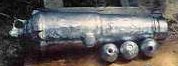
Platinum Cannon Shipwreck |
|
| Joe
Champion | David
Hudson(semi-technical lecture) | David
Hudson(made easy) | 20th
Century Alchemy(3 Chapters)
|
| The Platinum Cannon Shipwreck | The Mango Metal Report(3 chapters) | Bookstore | |
|
THERMAL 2 EXPERIMENT First is the laboratory report of the "Thermal 2 Experiment. 11 Thermal 2 uses empirically pure chemicals. This experiment, and the Thermal 4 Experiment, described later in this chapter, were two of the many tests conducted at Texas A&M University in College Station, Texas. Thermal 2 Experiment was accomplished on May 22, 1992 by Drs. Bockris, Monti, Bhardwaj, Lin, Mr. Minevski and me. The assay results from ICP(Inductive Coupled Plasma) analysis were obtained on June 2, 1992.The assay indicated that the product of the mixture after ignition contained about 570 parts per million (ppm) of gold. Since reagent (high purity) chemicals were used, there was no gold in the mixture before initiating transmutation. The 570 parts per million of gold in the after treatment material indicated this amount of gold was created, i.e., transmuted out of a mixture of chemicals containing no gold before treatment.
The total mixture of chemicals and the weight of each chemical used in Thermal 2 are shown on the following page. The total weight of the chemicals was 1,715 grams (g). The chemicals were weighed separately and then mixed together. Ninety (90) grams of mixture was sent for analysis. The remaining 1,625 grams were ignited by a torch in an empty 2.5 pound coffee can. The fire lasted about 90 seconds. The weighing, mixing, and firing were accomplished by Drs. Lin and Monti. This completed the process of transmutation. The next step was to analyze the amount of transmutation we achieved. CHEMICALS USED IN THERMAL 2 EXPERIMENT
The mixture had melted during the firing process into a rock?like substance which appears very similar to solidified lava from a volcano. After cooling down, the product was crushed into powder to about the consistency of talc powder (200 mesh). This was done in an impact mill. The pulverizing was accomplished by Dr. Monti and Mr. Minevski. The total weight of the after ignition product powder was 849 grams. Two methods were used to analyze the powder residue from the burn. The first method used a TWO?STEP procedure. The TWO-STEP method was conducted by Drs. Lin and Monti as follows: 1 . In the first of two steps, thirty (30) grams of the total of 849 grams of residue powder was placed in a crucible, a special container capable of withstanding the high temperatures of a furnace. Standard ore flux of 150 grams was added to the 30 grams of product and thoroughly mixed. The flux was Action Mining Services', the chemical formula of which is PbO, Na2B4O7, SiO2, Na2CO3. Thirty (30) grams of sodium borate (Fisher) was added on top the mixture. Two 12-inch nails were then inserted into the mixture. 2. The crucible was placed into a furnace and heated to 1,100° C for about two hours. At the end of two hours, the mixture had become molten. The appearance was very similar to what lava looks like before it cools and hardens. 3. The crucible was removed from the furnace and the molten mixture was carefully poured into a steel mold. 4. After separating the two parts, the lead was found to weigh 61 grams and the slag weighed 104 grams. 5. The slag was then crushed into powder by the impact mill. The powder was again weighed and found to equal 101 grams. Three grams were lost in the crushing action. This was considered normal. 6. The 101 grams of slag
was mixed with 101 grams powder residue and 1,010 grams standard flux.
|
|
 Another
Mystery
Another
Mystery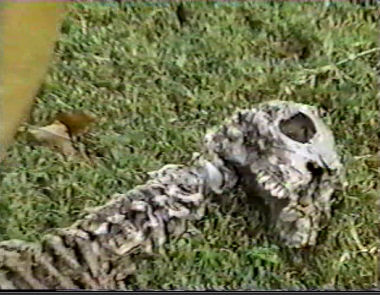
|
| Joe
Champion | David
Hudson(semi-technical lecture) | David
Hudson(made easy) | 20th
Century Alchemy(3 Chapters)
|
| The Platinum Cannon Shipwreck | The Mango Metal Report(3 chapters) | Bookstore | |
|
Copyright©2014
Globe Merchant |