|
|
The
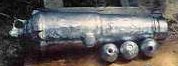
Platinum Cannon Shipwreck |
|
| Joe
Champion | David
Hudson(semi-technical lecture) | David
Hudson(made easy) | 20th
Century Alchemy(3 Chapters)
|
| The Platinum Cannon Shipwreck | The Mango Metal Report(3 chapters) | Bookstore | |
|
7. The slag mixture and the lead were separated into two equal parts. 8. The SECOND STEP of the TWO-STEP method, conducted by Drs. Monti and Lin, was to place the slag mixtures and the two lead pieces into two crucibles. Each crucible had one part of the slag and one part of the lead. The lead was buried deep in the mixture. Forty(40) grams of sodium borate was layered on top. Two nails were inserted into each crucible as before. 9. The crucibles were heated to 1,100°C for about two hours, thus entering the mixture into a molten state. 10. The molten mixtures were poured into separate steel molds and allowed to cool to room temperature. 11. The lead parts were separated mechanically from the glassy slag and weighed. The total weight for the lead pieces was 472 grams. 12. The lead pieces were cut into eight parts and each piece was placed in a cupel. 13. The cupels were heated in a furnace to 950°C for 23 hours. After becoming molten and cooled, each cupel had a bead. Dr. Monti weighed the eight beads and arrived at a total weight of 0.716 grams. The beads were then set aside temporarily for future use in ICP measurements. The SECOND METHOD used only ONE STEP in the preparation for analysis procedure. This method was very similar to the first step (number 1 through 7 above) of the two?step treatment, except that the slag measurement is omitted. Of the remaining 819 grams (30 grams were used in the first method), 481 grams were removed for the second procedure. The 481 grams of powder was mixed with flux in the ratio of 1:5. Four hundred (400) grams of powder was mixed with flux by Dr. Bhardwaj, 30 grams and flux were mixed by Drs. Lin and Monti, and 51 grams were mixed with flux by Dr. Monti. The total mixture was divided and placed into eight crucibles. The procedure for treatment was the same as was described above in steps one through seven, with the exception the slag is omitted. The cupels were heated to 950°C for 2?3 hours. After removal from the furnace and cooled, the slag was separated from the pieces of lead and discarded. The weight of all the lead was 980 grams and was mechanically separated into smaller parts. Each part of the lead was positioned in a cupel, placed in the furnace and, after becoming molten and cooled, weighed out to a total of 3.44 grams. From the beads, 3.3 grams were used for the ICP measurement and 0.14 grams was used for the EDS (Electron Dispersing Spectroscopy or, better known as the Electron Microscope) measurements. This part of the experiment was done by Dr. Monti. ICP ANALYSIS--THERMAL 2 EXPERIMENT For the purposes of Thermal 2 Experiment, although there are other precious metals in the residue powder, we only wished to determine the amount of transmuted gold. The steps taken were as follows. 1. First, we prepared the ICP standard. 8.9 milligrams of gold was dissolved in 50 milliliters of 10% aqua regia solution. Then 5 milliliters of this solution was diluted into 50 milliliters for the ICP measurement. The ICP measurement of the gold in the standard solution was entered as 17.8 parts per million. 2. The beads from the TWO?STEP (first) method, a total of 0.716 grams and 3.3 grams from the second method were used in the ICP measurement. 3. The beads were placed separately into 50 milliliters of 20% nitric acid solutions for 2?3 hours. Some of the metals dissolve, but the gold does not. The solution is filtered, leaving an undissolved residue in the filter. 4. The undissolved portions are then dissolved separately in 5 milliliters of aqua regia solutions. This dissolves the gold and places it into the solution. 5. Five milliliters of both of the resulting solutions were diluted to 50 milliliters for the ICP measurement. These steps were accomplished by Dr. Bhardwaj and Mr. Minevski. The ICP measurement of the
concentration of gold in the samples prepared by the TWO-STEP method
and the SECOND METHOD were 132.8 parts per million (ppm) and 445.9 parts
per million (ppm), respectively. Dr. Larry UnRuhe of the Texas A&M
Agriculture Department conducted the assay.
|
|
 Another
Mystery
Another
Mystery
|
| Joe
Champion | David
Hudson(semi-technical lecture) | David
Hudson(made easy) | 20th
Century Alchemy(3 Chapters)
|
| The Platinum Cannon Shipwreck | The Mango Metal Report(3 chapters) | Bookstore | |
|
Copyright©2014
Globe Merchant |