|
|
The
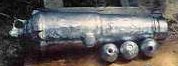
Platinum Cannon Shipwreck |
|
| Joe
Champion | David
Hudson(semi-technical lecture) | David
Hudson(made easy) | 20th
Century Alchemy(3 Chapters)
|
| The Platinum Cannon Shipwreck | The Mango Metal Report(3 chapters) | Bookstore | |
|
12. The slag from the 111.5 grams and 58 grams lead samples were then simultaneously crushed in the impact mill and the total weight of the slag powder was noted to be 330 grains. Three hundred(300) grams of the powder was then mixed with 900 grams of flux and a 180 gram layer of sodium borate was added on top. The sample was then divided into six parts and placed in crucibles. Nails were inserted into the six crucibles. After running the crucibles through the furnace and separating the lead pieces from the slag, the total weight of the lead was 365 grams. The cupel process was repeated and 10 silver colored beads were retrieved. The total weight was 0.02 grams. This showed that this slag did not contain significant amounts of gold. The weight of gold extracted
from Thermal 4 Experiment was estimated to be 170 milligrams. The total
mineral 2 used was 100 grams. UPSCALING TO COMMERCIAL LEVELS The following transmutation examples are based around yet another set of conditions, in this case to determine upscalibility to commercial production levels. Now, the important question was, will the process upscale on a linear factor? To justify this question, a new series of controlled experiments were conducted within the confines of Mid-States Recycling facilities in Rosemont, Illinois. To start, I decided to once again repeat the experiments conducted at Texas A&M. This decision was based on Mid-States equipment being different from the equipment used in the previous experiments. Mid-States have inductive furnaces, whereas in the past these experiments had been conducted either in alloyed cans or graphite crucibles in gas-fired furnaces. The point of trying the new furnaces was to determine if after the transmutation occurred, could we raise the temperature sufficiently to allow a one-step recovery? In order to have demographic data available, it was necessary to start with a known reaction. Therefore, we had to go back to the same experiments we conducted before. To date, transmutation has occurred in all experiments at Mid-States except for one experiment conducted by Texas A&M scientists (see Chapter I). A problem did exist with the recovery process in the initial tests at Mid?States. To explain, during the first four heated reactions, only 25% of the metals were recovered. Recovery percentages were based on quantitative gold recovery only. After the minimal recovery, the slag was placed in the furnace. The results proved that after the transmutation, the metals were remaining in an obscured state which required additional metallurgical flux for recovery. The staff at Mid?States has accumulative experience of over 100 years experience in dealing with metal recovery from different types of material. With this experience, they were able to determine that the precious metals were associating with the carbon. After this was learned, they attempted different procedures to ascertain the best collection process to use after the transmutation cycle. The best apparent process was to raise the temperature of the chemical matrix after transmutation occurs to temperatures in the range of 2,OOO°C. Within this temperature range, the silicon oxides would dissociate, thus causing free oxygen within the reaction. This allows for oxidization of the carbon. This process caused an increase in recovery of precious metals within the primary process. End of Experimental Examples
|
|
 Another
Mystery
Another
Mystery
|
| Joe
Champion | David
Hudson(semi-technical lecture) | David
Hudson(made easy) | 20th
Century Alchemy(3 Chapters)
|
| The Platinum Cannon Shipwreck | The Mango Metal Report(3 chapters) | Bookstore | |
|
Copyright©2014
Globe Merchant |