|
|
The
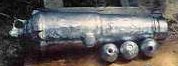
Platinum Cannon Shipwreck |
|
| Joe
Champion | David
Hudson(semi-technical lecture) | David
Hudson(made easy) | 20th
Century Alchemy(3 Chapters)
|
| The Platinum Cannon Shipwreck | The Mango Metal Report(3 chapters) | Bookstore | |
|
Analytical History The following is based on documentation supplied by Mr. David Econopouly a principle of Mango Metal Partnership. December 1990 -- Vern McMahon, Ph.D. of Auro Research Laboratory tested an unknown bar from the metallic artifacts. The results obtained by electromagnetic assay(?) said that the bar contained ~37.81% by weight of rhodium metal. January 1992-- Mr. C.W. Ammens(C.W. Ammens is a respected metallurgist and his practices are in line with those of the Coloragdo School of Mines. He is also author of "Recovery and Refining of Precious Metals". Van Nostrand Reinhold, copyright 1984) reported that the bars contained an average of 38% rhodiurn metal. Type of analysis was not released. July 1992 -- Mr. Dayne Chastian, an independent assayer and refiner reported the following: · Cannon ball -- Gold, Rhodium and Iridium in concentrations of 30-40% with gold being the predominate metal. · Black Rock -- Gold, Rhodium and Iridium in concentrations of 30-40%. · Rock Samples -- Gold, Rhodium and Iridium in 3-4% quantities. No mention was made as to the type of analytical procedure utilized in the report. However, in a subsequent telephone conversation prior to this report, Mr. Chastian reported that he used standard digestion technologies with resin collection (final collection in lead), collection in copper and electro?dligestion (also an industrial standard process) and direct scorification and cupellation September 1992 -- Mr. Zig Bremmer and associates from Germany, all of Bremmer Technology Corporation, Scottsdale, Arizona reported the following:
Here one can observe a repeatability of analysis. However, please note that the samples were prepared by scorification in lead then analyzed by a Direct Coupled Plasma Electron Spectrometer (DCP). In an explanation letter Mr. Bremmer noted that the platinum was in a form of clusters and could not be considered as "free metals." He continued by stating, if you want to break the metallic clusters it is necessary to use Bremmer Technology. September 1992 -- The Institute for Spectrographic Research reported that samples from the cannon and cannon ball were analyzed by X-ray florescence and they found a high concentration of gold and the platinum metals. November 1993 -- Analysis by an unnamed laboratory reported the qualitative presence of elements as follows: · Tan Sample (clay) -- magnesium, aluminum, silicon, chlorine, calcium and a trace amount of iron · Cannon -- iron (no other metals reported) · Black Rock -- iron, silicon, calcium, titanium, with trace amounts of aluminum and magnesium August 1996 -- American Society for Applied Technology located in Silver City, New Mexico performed various assays on a bar, cannon and precipitates (?). Using standard metallurgical fire assay techniques they reported no precious metals by cuppellation. Following is a Scanning Electron Microscopy (SEM) report on the cannon: · Cannon -- iron, manganese and sulfur August 1996 -- In a separate document the American Society for Applied Technology reported that a sample from the black rocks contained +.99% silver. EVEN THOUGH ADDITIONAL HISTORICAL
DOCUMENTATION may appear in the future, this report will not be amended,
for this data establishes the fundamentals.
|
|
 Another
Mystery
Another
Mystery
|
| Joe
Champion | David
Hudson(semi-technical lecture) | David
Hudson(made easy) | 20th
Century Alchemy(3 Chapters)
|
| The Platinum Cannon Shipwreck | The Mango Metal Report(3 chapters) | Bookstore | |
|
Copyright©2014
Globe Merchant |