|
|
The
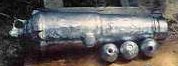
Platinum Cannon Shipwreck |
|
| Joe
Champion | David
Hudson(semi-technical lecture) | David
Hudson(made easy) | 20th
Century Alchemy(3 Chapters)
|
| The Platinum Cannon Shipwreck | The Mango Metal Report(3 chapters) | Bookstore | |
|
The production of transmuted isotopes can be achieved by numerous chemical reactions, assuming that one has the basic understanding of the process. In a thermal process, it is necessary to achieve two major components: heat and resonance. Heat can be generated by several means, but most common is the following general formula: C + S + KN03 + FeS04 + (0) There are several variations which can be applied to the above, such as: K(CN)2 + KN03 + NaN03 Other forms of heat can be generated with gases, although an imminent danger is present with such reactions. Within the heat matrix a fundamental resonance function is due to SiO2 (silicon oxide) in the form of quartz crystals. SiO2 creates the resonance conditions for the absorption of the energy of the nuclei. Gold (Au) and silver (Ag) act as catalysts of the fission of the basic metals such as lead (Pb) and mercury (Hg). Since chemical reactions start nuclear reactions, it is useful to counterbalance the "positive" energy obtained by the nuclear fissions of heavy elements (Pb, Hg) with "negative" energy nuclear fissions of the lighter isotopes. To this aim, cadmium (Cd) is an important element. Consider as an example the following matrix of chemicals: COMMON CHEMICAL MATRIX AND CHEMICAL PURPOSES
(13.2%) Hg201 - a --->
Pt197 --- > Au197 + b and the following endoenergetic reactions: (51.83%) Ag107 - a --->
Rh103 In what precedes, we have considered only "cold fission" reactions. But maybe other, different nuclear reactions are occurring in the compound. To synthetically produce
precious metals, I have laid out two basic programs. One is with empirically
pure chemicals. The second uses mineralized black sands with only a
trace of gold.
|
|
 Another
Mystery
Another
Mystery
|
| Joe
Champion | David
Hudson(semi-technical lecture) | David
Hudson(made easy) | 20th
Century Alchemy(3 Chapters)
|
| The Platinum Cannon Shipwreck | The Mango Metal Report(3 chapters) | Bookstore | |
|
Copyright©2014
Globe Merchant |